The Renovation Decisions That Matter More Than Finishes
I know what happens when you start planning a renovation.
You open Pinterest. You save tile samples. You debate paint colors with your partner over morning coffee. Because that’s what feels tangible. That’s what you can see.
And I understand why. Finishes are exciting. They’re the part everyone notices.
But here’s what I’ve learned after guiding hundreds of clients through major renovations: the decisions that will actually determine whether you love living in your home happen much earlier. And they’re rarely the ones people think to ask about first.
They’re the decisions that govern how you move through your home.
How supported you feel in your daily routines.
How calm or chaotic the space becomes over time.
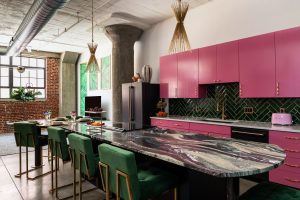
In this space-challenged loft renovation, we decided to remove the free-standing dining table that took up too much room in the living space. Instead, we enlarged and angled the countertop to accommodate seating for 9 people, 10 in a pinch. The space is now perfect for entertaining or cozy meals for 2./Photo by Karen Palmer
The questions no one asks first (but should)
Before we ever discuss finishes, I’m asking questions that rarely make it onto your inspiration boards.
How does this space actually function on a weekday morning?
Where do you hesitate, collide, or feel rushed?
What feels inconvenient now and what will feel exhausting a year from now?
You often sense these issues but struggle to name them. Clients describe it perfectly: “I just feel stuck in my own kitchen.” Not a visual problem. A lived one.
When we don’t address these friction points early while they can still be resolved thoughtfully,people end up with spaces that look beautiful but feel strangely unsatisfying. I don’t want that for you.
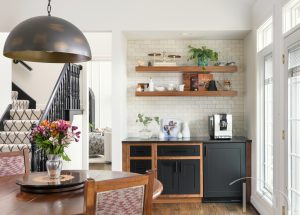
We took the original desk area and turned it into a coffee bar, easily accessible from the breakfast table and never in the way of the cooking area. Behind the coffee bar is the liquor bar. Morning or night, a bar is close by. /Photo by Karen Palmer.
Why flow matters more than you think
I’ll be honest: flow is one of the most underestimated elements of design. When it’s right, you barely notice it. When it’s wrong, it quietly undermines everything else.
Flow is about how rooms connect to each other.
How doors open and close around your actual furniture.
How pathways and sightlines work throughout your real, daily life.
I’ve walked into impeccably finished homes that feel awkward because circulation wasn’t carefully considered first. The tile is gorgeous. The room never quite works. And you feel it every single day.
When we get flow right from the beginning, your space starts to feel intuitive. Almost effortless. The aesthetic choices enhance the experience instead of trying to compensate for foundational problems you shouldn’t have had in the first place.
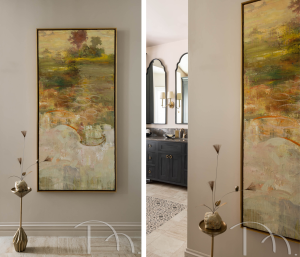
This beautiful piece of art can be seen from the primary bedroom. Take a step to the left for access to the primary bathroom. Take a step to the right to access the water closet and clothes closet. This renovation took an all-in-one-room bath and separated the spaces for a much better traffic flow, without increasing the square footage. /Photo by Karen Palmer
___________________________
Comfort is designed, not accidental
Here’s something I tell every client: comfort doesn’t just happen. We design it into your home.
Clearances that let two people move through the space without that awkward side-shuffle.
Seating that supports how you actually relax, not just how it photographs.
Lighting that flatters both your rooms and the people you love.
These decisions rarely draw attention, but you feel their absence immediately. I’ve had clients tell me, months after we’ve finished, “I never realized why my old living room felt so uncomfortable until now.”
We prioritize comfort early because it’s difficult and costly to correct later. Once walls are placed and layouts are locked in, your options become constrained. But when we design for it from the beginning? Your home welcomes you instead of requiring adjustment.
___________________________

Our clients voiced many “needs” for this living room. Space for plants (lots of plants), as much seating as possible, an elegant yet cozy feel, and a chaise lounge specifically for the woman of the house. Mission accomplished. /Photo by Karen Palmer.
___________________________
The maintenance conversation we need to have
One of the most common renovation regrets I hear isn’t about aesthetics. It’s about upkeep.
Surfaces that require constant sealing.
Materials that show every fingerprint and water spot.
Finishes that demand more attention than your actual life allows.
You didn’t invest in a renovation to become its caretaker. So when we evaluate materials together, I’m looking beyond installation day. I’m thinking about how they age, how you’ll clean them, and how forgiving they are when life inevitably happens.
Because it will. And your home should be built for your real life, not a hypothetical perfect one.
This is why finishes come last.
When we make the foundational decisions thoughtfully, layout, flow, comfort, maintenance, and choosing finishes become a pleasure rather than a source of stress.
They enhance a space that already works instead of trying to rescue one that doesn’t.
That’s why I don’t rush them. And that’s why I spend so much time on the decisions that happen before you ever see a sample board.
Good design isn’t about choosing the right tile. It’s about making the right decisions in the right order, so your finished space feels calm, supportive, and genuinely aligned with the way you actually live.
If you’re planning a renovation, I’d encourage you to start with the decisions that will matter long after the dust settles. Everything else follows more naturally from there.
And if you’d like a partner who’ll ask these questions with you, someone who’s been through this process enough times to know where the pitfalls hide, We’re here. That’s what this work is really about.
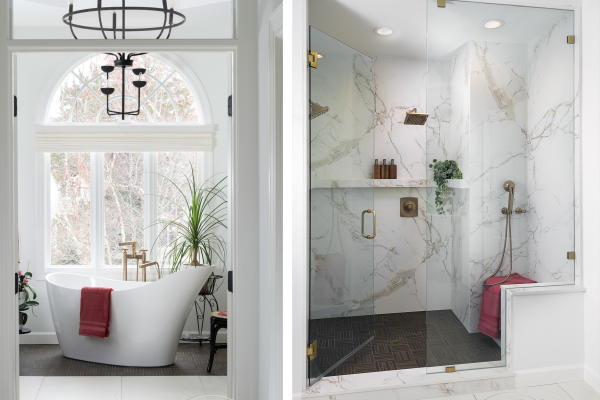
Rather than using just one floor tile in this bathroom, we chose two. The dark porcelain mosaic that looks like wood parquet highlights the tub area as a separate space. The shower walls may look like marble, but they are actually clad in a carbon-neutral, ultra-compact porcelain surface by Cosentino. The look of marble without the upkeep. /Photos by Karen Palmer.
___________________________