What We Mean When We Say Luxury
The word gets used a lot in this industry. Luxury kitchen. Luxury primary suite. Luxury finish package.
It has started to mean almost nothing.
So let me tell you what I mean when I say it, because after forty years of designing homes, the definition I work from has almost nothing to do with the one you’ll find on a showroom floor.
Luxury is not a price point.
I know. Controversial opinion from someone who designs at the upper end of the market. But follow me here.
I have been inside extraordinarily expensive homes that felt anxious. Rooms full of things that cost more than most people’s cars, arranged in ways that made you feel like you shouldn’t sit down. That is not luxury. That is insecurity dressed up in very good materials.
I have also been inside homes of more modest means that felt genuinely, deeply restful. Where every choice had been made with conviction and the room knew what it was. That feeling — that quality — is what I’m after. Always. In every project. At every budget.
Luxury, as I use the word, is about intention. A room that has been thought through rather than assembled. A space that makes decisions. A home that knows what it’s for.
The ceiling nobody was looking at.
This University City project is a good example of what I mean.
The main living room had a barrel-vaulted ceiling — a genuinely beautiful architectural feature that had been painted white and was doing absolutely nothing. Nobody looked up. Nobody noticed it. It was just… there.
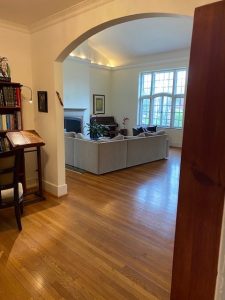
Before the Magic! Photo by Marcia Moore.
We painted it in a bronze metallic. That’s it. No new construction. No structural change. Just the decision to treat that ceiling as the extraordinary thing it truly is.
The room changed completely.
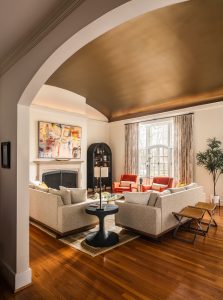
AFTER the magic – living in luxury now! /Photo by Karen Palmer Photography.
That is the difference between decoration and design. Decoration would have found a beautiful sofa. Design looked up, noticed what was already there, and asked what it would take to make it sing.
The answer, in this case, was paint and conviction. Not a bigger budget. A better question.
What it actually looks like.
The most luxurious rooms I’ve designed don’t announce themselves. They don’t have a feature wall with a brass inlay and a statement chandelier over a seven-piece sectional. They have, instead, an immediate sense of calm. You walk in and something settles.
That feeling comes from restraint. From proportion. From a room where nothing is fighting anything else for your attention.
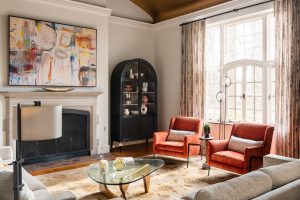
Rusty orange velvet warms this room even when the fireplace is not lit./Photo by Karen Palmer Photography.
___________________________
Look at the color story in this room. The sofas are warm neutral — they recede and let the room breathe. The rust velvet chairs are the single color commitment, positioned at the window where the natural light hits them. The black arched cabinet grounds the fireplace wall. The art gives the room permission to be expressive without the furniture competing for the same attention.
One color story, told with conviction. Not a trend. A decision.
The focal point problem.
Every room needs one thing it’s organized around. One thing the eye goes to first and the rest of the room defers to.
In this living room, that’s the fireplace wall — anchored by the limestone surround, the art scaled correctly above it, the barrel vault drawing the eye upward. Everything else in the room is in conversation with that wall, not competing with it.
___________________________
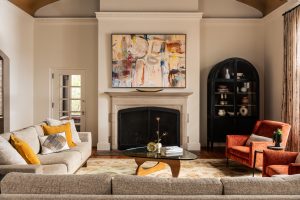
I love how the slight arch of the fireplace is mimicked in the base of the coffee table and inverted in the shallow bowl above it./Photo by Karen Palmer Photography.
___________________________
This is where a lot of rooms go wrong. They have four focal points — a gallery wall, a statement sofa, a large window, and a fireplace — and the room feels unsettled because your eye doesn’t know where to land. That unsettled feeling is what clients describe when they say a room ‘just doesn’t feel right.’ They can’t name the problem. The problem is that nothing is in charge.
Design is about making that decision. Choosing the thing and committing to it. Letting everything else support rather than compete.
Every piece earning its place.
The other half of the luxury equation is editing. Not just what you add — what you choose not to add.
In this living room, the corner near the window is a good example of this. Two rust chairs. A single side table. A floor lamp that provides the layered light the room needs at that corner after dark. A glass-topped coffee table that doesn’t interrupt the visual weight of the rug. Nothing extra. Nothing decorative for the sake of it.
___________________________
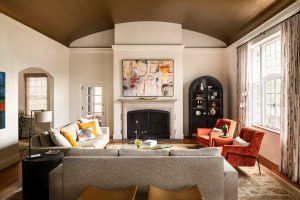
Two extra stools reside behind the sofa until they need to be pulled into the room, keeping the back of the sofa from feeling bare. /Photo by Karen Palmer Photography.
___________________________
The cabinet is curated — not stuffed. The objects on the shelves have breathing room. That breathing room is part of the design.
Editing is one of the most underrated skills in this work. Not because it’s technically difficult — because it requires knowing what the room is for and having the conviction to remove everything that doesn’t serve that purpose. Most people add. The designer’s job is often to subtract.
What this means when you’re planning a project.
If you’re starting a renovation or a new build and you find yourself focused primarily on finishes — tile selections, hardware finishes, paint colors — I’d gently suggest stepping back for a moment.
The finishes matter. But they’re not the decisions that will determine whether you love living in your home ten years from now.
The decisions that matter are the ones about how the room works. What it’s organized around. What the ceiling is doing. Whether the scale is right. Whether the color story has a point of view.
A bronze ceiling doesn’t cost what a gut renovation costs. But it takes the kind of designer who looked up, noticed something, and had the conviction to do something about it.
That’s what we mean when we say luxury.
Ready to have that conversation?
Book a consultation → marciamooredesign.com/contact